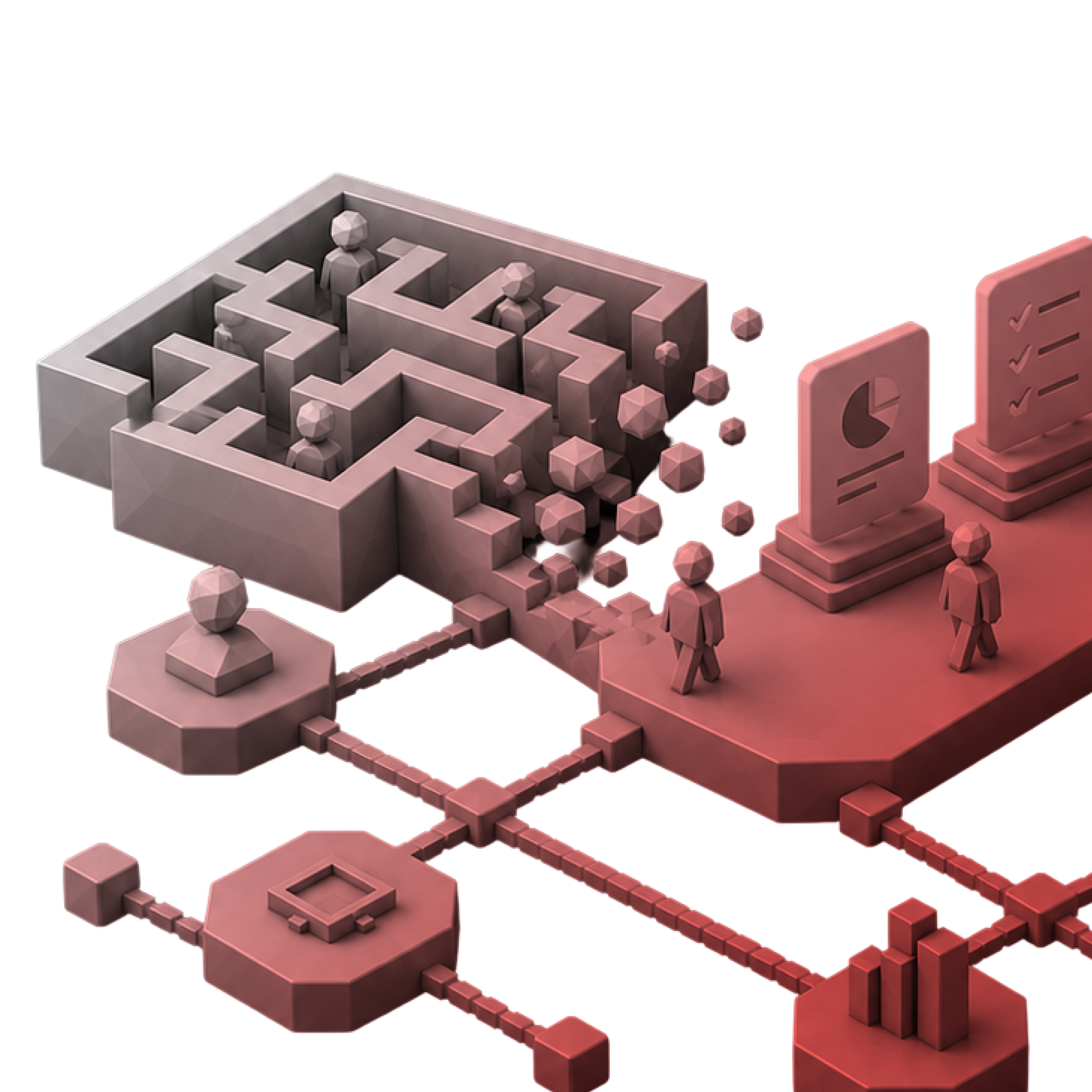
Most design work stops at the screen. Service design does not. It looks at the whole experience a customer has with an organisation — the app, the website, the call centre, the counter, the email, the person who hands over the keys — and the people, processes, and systems behind each of those moments. When customers complain about a “bad experience”, the cause is rarely a single screen. It is usually a gap between channels, teams, or steps that nobody owns.
That makes service design agencies different from UI studios. They map current journeys and service blueprints, find where front-stage moments break because of back-stage processes, and redesign both together. The work involves customers, frontline staff, operations, and leadership, and the output is often a mix of digital products, new processes, and new roles.
Good service design is measurable: fewer handoffs, fewer support calls, faster completion, less manual work. The best service design agencies combine research, systems thinking, and the ability to ship real digital touchpoints, so the blueprint does not stay on a wall. For a deeper primer, see our guide to service design and CX.
For SIXT, the global car rental company operating in 130+ countries and 2,000+ locations, NetBramha looked beyond the booking screens. The team identified the key on-ground touchpoints at pickup and redesigned them for automation, so customers can complete pickups and transactions with minimal staff assistance. Web and app were aligned into one modular platform, giving SIXT a consistent experience across markets and faster rollouts.
For Emaar ONE, NetBramha unified five separate offline processes into a single resident app covering 100,000+ properties, including service requests by voice. That is service design in practice: removing handoffs between teams by redesigning the service itself, not just its interface.
Physical and digital moments must work together — SIXT shows redesigned on-ground pickup flows.
Fragmented offline processes need one front door — Emaar ONE unified five processes into one app.
The service runs in many markets — SIXT's platform supports consistent rollout across 130+ countries.
Organisational change management — NetBramha designs the service and touchpoints; confirm who leads internal process and role changes.
Public sector services — confirm experience with government procurement and policy constraints.
Fjord is one of the best-known names in service design and now sits inside Accenture Song, which gives it the scale to carry blueprints into large technology and operations programmes.
The service spans many systems — service design is their heritage.
Rollout is global — Accenture supports delivery.
Technology change is part of the plan — they connect design to implementation.
Senior attention — confirm staffing model and who leads day to day.
Budget — large consultancy rates apply.
IDEO is known for deep human-centred research and rapid prototyping of new service concepts, useful when an organisation wants to rethink what the service should be.
The service needs a new model — they explore concepts broadly.
Customer needs are unclear — they research real behaviour.
Leadership needs a vision — their prototypes make ideas tangible.
Production execution — confirm capacity to build the digital touchpoints.
Speed — their research takes time.
Designit combines strategic and service design with engineering capacity from Wipro, useful when a new service model needs systems built to support it.
Build capacity is needed — Wipro's capacity supports implementation.
Markets are multiple — their studios span regions.
Back-stage systems must change — they design across service and technology.
Boutique attention — confirm team composition.
Relevant examples — ask for service work in your sector.
Deloitte Digital places service design inside Deloitte's consulting practice, useful when new journeys depend on changes to processes, roles, and governance.
Operating models must change — they connect design to operations.
Programmes are large — they staff at scale.
Compliance is heavy — they connect design to governance.
Design depth — confirm the design team's role versus consultants.
Cost — large consultancy rates apply.
frog designs products, services, and hardware as one system, useful for services where devices, spaces, and apps all shape the experience.
Physical touchpoints matter — they design across hardware and software.
Strategy is needed — they connect design to roadmap.
The brand experience matters — they design end to end.
Budget — their model suits large programmes.
Service design examples — ask for directly relevant work.
Do they look back-stage? Ask how they map the people, processes, and systems behind each customer moment, not just the screens.
Do they involve frontline staff? Staff know where the service breaks. Ask how they research and co-design with them.
Can they ship the touchpoints? A blueprint is only useful if it becomes real apps, tools, and processes. Ask for examples that launched.
How do they measure success? Ask which service metrics they track, such as handoffs, support calls, completion time, and manual effort.
Who owns the change? Ask how they hand over to internal teams and support adoption after launch.
How much does service design cost?
A discovery and blueprint for one service typically runs $30,000–$90,000. A full redesign including digital touchpoints typically runs $120,000–$400,000 or more.
Should I use a service design specialist or a product agency?
A specialist is strong on research and blueprints. An agency that also designs and ships products helps make sure the blueprint turns into working apps and tools.
How long does a service design project take?
Discovery and blueprinting take 6–12 weeks. Full redesigns take 4–12 months, depending on how many channels and teams are involved.
UX practice and digital product expectations differ by region — what signals quality and trust to a buyer in the US or UK is different from Dubai or Singapore. An agency with direct market experience brings depth that cross-industry portfolios cannot substitute.