.avif)



.avif)





Unparalleled insights tailored to empower your business.
Robust strategies with the agility demanded by today’s digital landscape.
Creating experiences that resonate with users and drive results.
There are 600 fintech companies operating in London. Hundreds of SaaS products competing for the same enterprise buyers. The product that closes the deal is rarely the most technically capable one. It is the one whose experience made the buyer feel confident enough to sign.
Every week you carry a broken onboarding flow, a confusing dashboard, or a trial experience that does not convert, a competitor with a cleaner product is winning the deal you should have won. They are not winning on features. They are winning on feel. And feel is a design problem with a design solution.
Research shows users decide whether a product is worth their time within the first few minutes of using it. In London's enterprise market, where procurement cycles are long and switching costs are real, that first impression has an outsized commercial weight. A buyer who struggles in the trial does not give the product a second chance.
They write a note in their evaluation scorecard and move on.The product teams that understand this invest in the experience before the sales cycle, not after they have already lost deals they cannot explain. The ones that do not are having the same conversation with their sales team every quarter: the product is good, the demos go well, but something is breaking down after the trial starts.That something is almost always design.
UX debt compounds. Workarounds become training documents. Broken flows get features built on top of them. The cost of fixing the experience six months from now is higher than fixing it today, and the revenue lost in the meantime does not come back.
NetBramha works with London teams remotely without any drop in quality. IST overlaps with UK morning hours for live sessions. The first engagement is scoped around the one or two flows that are costing you the most commercially right now, not a full redesign that takes a year to ship
If your product is losing trials it should convert, or renewing accounts it should be expanding, the experience layer is almost certainly part of the reason.
NetBramha will tell you in 30 minutes whether that is true for your specific product and what it would realistically take to fix it.No deck. No proposal before we understand the problem.
No commitment until you are certain we are the right studio. Talk to NetBramha.

billion+ lives impacted with design so far
250+ Clients
25+ Countries
20+ Industries


They understand the user’s needs, research options out in the market, present different approaches, etc. I like how the designers feel passionately about my product & company. They’re not just trying to punch the clock.

Their attention to detail and willingness to do one extra iteration to get it right was impressive. Hard-working, no-nonsense bunch who were willing to roll their sleeves up. I genuinely believe they’re one of the best in the business.

Web traffic and conversions increased due to NetBramha Studios’ expertise. Their knowledge of UX/UI led to SEO improvements for the client. Their team’s innovative ideas set them apart from competitors.

NetBramha made sure the project is delivered to its best and had scope to upgrade as often as needed and even proposed ideas to enhance the Digital Footprint efficiency of Luminous through UX-UI uniformity and intersecting use cases.





A startup or for a Fortune 500 company, we follow a methodical & consistent approach to every design project we work on
Research – In-depth analysis of users through qualitative & quantitative analysis, ethnographic research, heuristic evaluation (through design audits), & usability testing, along with detailed competitor analysis.
Strategy – Powered by the insights derived in the research stage, we then work towards building a customer-centric product roadmap aimed at enhancing growth, product stickiness & market capture, through increased user engagement.
Design – Rugged information architecture, product mock-ups, user interface design, detailed motion & microinteractions, and finally customized illustrations & icons that set the apt succinct identity for your final product.
Since our inception 17+ years back our work has impacted more than a billion+ users worldwide. We take great pride in making a difference with design.
As an award-winning studio from India, our expertise involves everything that is needed to design (or redesign) a great user experience, including
– Website & Web app UX design
– Mobile UI/UX experience
– Enterprise UX design
– Branding & Illustrations
All of which is facilitated by rugged user research, product strategy, design thinking & deep craft for design.
We care for - People. (our team, clients & users)
Our people are our biggest strength. We care for our team & each one of them is hand-picked. Our culture is what drives us. Our care for our customers to see their problem as ours & empathy for the users is what makes us tick.
We care for - Design. (craft, outcomes, process)
We are absolutely passionate about design. We contribute to the design community, build our expertise & hone our skills every single day. We truly believe that design can change the world for better.
We care for - Outcomes (results, wins, learnings)
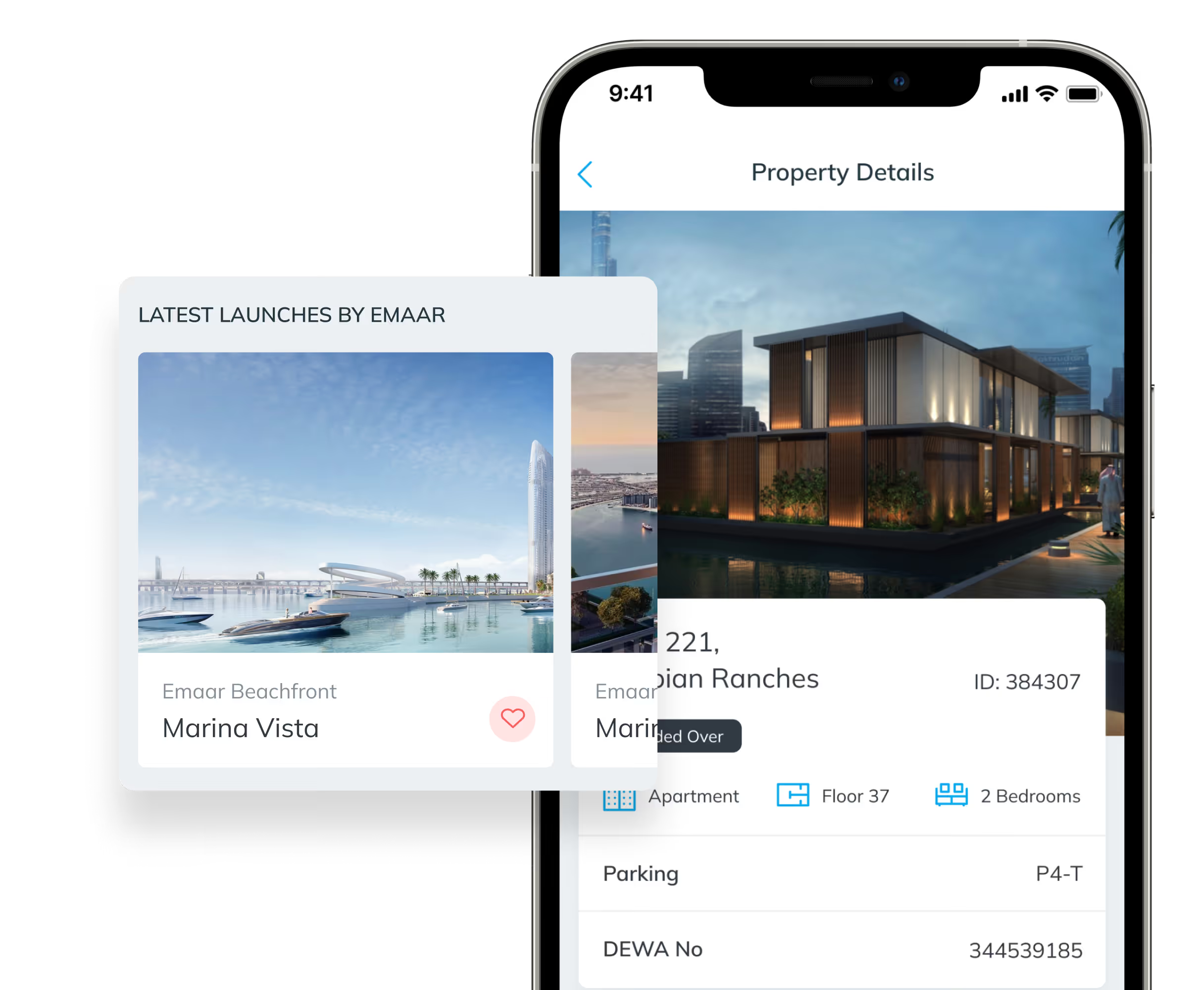
We are result driven & backed with experience. Our clients trust us to deliver results across experiences. Clients like Google, Microsoft, Cisco, Intel, Infosys, Emaar etc have mandated us to design new products, scale existing products or disrupt a new market with design.
London is the largest fintech hub in Europe, with more Series A to D funded fintech companies than any other city outside the US. The UX challenge in London fintech is specific: products need to work for both digitally native millennials and traditional finance professionals, often within the same platform.
NetBramha's fintech and finance design practice has worked across payments, open banking, spend management, and investment products globally and understands how to design for this dual audience without compromising either experience.
Designing for EMEA requires understanding that users in the UK, Germany, UAE, and South Africa have different mental models, different trust signals, and different expectations from a digital product, even when the product itself is the same.
NetBramha's experience across 20 countries and its work in both European and Middle Eastern markets makes it well positioned to conduct qualitative research across geographies and design products that localise without losing coherence. This is particularly relevant for London companies expanding into the GCC as part of post-Brexit market diversification.
UK accessibility requirements informed by WCAG 2.1 AA and the Equality Act 2010 are increasingly enforced for enterprise and public-facing digital products. NetBramha's visual design and information architecture practices are built with accessibility as a constraint from the start, not a retrofit at the end.
Colour contrast ratios, keyboard navigation, screen reader compatibility, and focus state management are all addressed during the design phase rather than flagged during a post-launch audit.






.avif)
.avif)