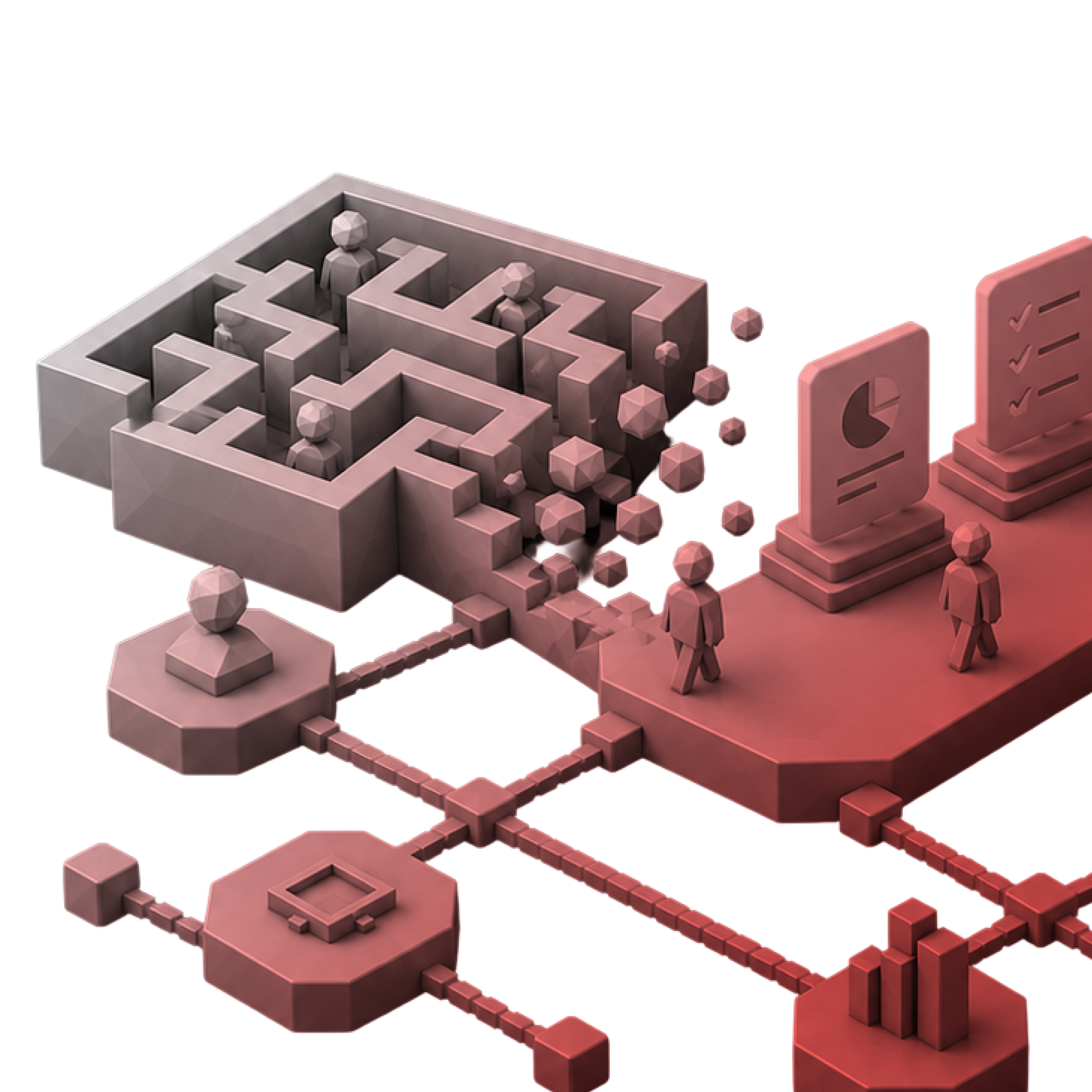
Property management platforms carry some of the largest financial relationships people ever have. Owners track payments and handover milestones on an asset worth years of income; residents raise service requests and expect them resolved; investors want visibility into construction progress and returns. Property management UX has to turn a long, multi-step relationship into something transparent and easy to manage, often after years of paperwork, phone calls, and site visits.
Real estate platform UX also serves many roles at once. Buyers compare projects and plots. Owners manage payments, documents, and handovers. Residents and tenants request maintenance. Facility teams, sales teams, and developers' own staff need dashboards and workflows behind the scenes. Property management software design has to connect all of these through one system without making any single user wade through screens meant for someone else.
Under the surface sit ERP and CRM systems, payment gateways, construction data, legal documents, and service operations. The best real estate product design partners consolidate fragmented offline processes into a coherent digital experience, design clear information architecture for long journeys, and build design systems that scale across projects and markets.
For Emaar Properties, NetBramha designed Emaar ONE, which brought five separate offline processes — payments, handovers, service requests, construction tracking, and document access — into one app. It now manages more than 100,000 properties across a $1B+ portfolio. The work included a modular design language, custom icon system, voice-enabled service requests, and information architecture built for long ownership journeys.
Their HoABL platform guided buyers through discovery and decision on high-value land purchases, and Planera shows clear design for planning tools with many linked elements — relevant to project, unit, and construction management.
Offline processes need consolidating — Emaar ONE unified five into one app.
Ownership journeys are long and complex — Emaar ONE covers payments through handover and service.
Buyers face high-stakes decisions — HoABL shows trust-building discovery flows.
Commercial leasing and facilities SaaS — confirm experience with landlord-side leasing workflows.
ERP integration — confirm how they work with your property ERP and engineering partner.
Work & Co brings senior-led interaction craft to consumer apps, useful for luxury developments where the resident app is part of the brand promise.
The brand is premium — their finish matches high-end positioning.
The app is a flagship touchpoint — they design premium consumer experiences.
Senior attention is needed — their model keeps senior people involved.
Budget — premium rates apply.
Back-office tools — their focus is consumer products.
Huge uses data and personalisation for brands with large customer bases, useful for developers and portals tailoring listings, offers, and communications.
Customer bases are large — they manage scale.
Personalisation matters — they design around data.
Experimentation is planned — they pair design with testing.
Operational workflows — confirm property operations experience.
New products without data — their approach relies on data.
Ueno keeps feature-rich products coherent across roles and states, suiting proptech platforms that serve owners, managers, and service teams.
Roles are many — they design role-based experiences.
Visual quality matters — their execution is premium.
The company is technology-led — they know SaaS conventions.
Budget — premium rates apply.
Real estate examples — ask for directly relevant work.
Fjord designs the full service across sales offices, construction sites, contact centres, and apps, with Accenture's delivery scale behind it.
Journeys cross physical and digital — service design is their heritage.
Rollout is large — Accenture supports delivery.
Change management is needed — they connect design to implementation.
Senior attention — confirm staffing model.
Focused app scope — their model leans toward broader programmes.
Designit combines strategic design with engineering capacity, useful for developers operating projects in several countries.
Projects span countries — their studios support localisation.
Build capacity is needed — Wipro's capacity supports implementation.
Service and product must align — they work across both.
Boutique attention — confirm team composition.
Real estate examples — ask for directly relevant work.
Have they consolidated offline processes? Ask for examples of turning paperwork, calls, and site visits into digital flows.
Can they design long journeys? Ownership spans years. Ask how they structure payments, milestones, and documents so owners always know where they stand.
Do they design for every role? Buyers, owners, residents, and staff need different views. Ask how they handle role-based experiences.
Can they work with your systems? Ask how they integrate with ERP, CRM, payments, and service operations.
How do they measure success? Ask which metrics they track, such as app adoption, self-service requests, and payment completion.
How much does property management platform UX design cost?
A focused engagement such as a resident app or payments flow typically runs $40,000–$130,000. A full ownership platform with a design system typically runs $150,000–$450,000.
Should I use a specialist or generalist agency?
A proptech specialist helps with leasing and facilities conventions. A strong product design agency works well when the challenge is consolidating fragmented processes into one clear experience.
How long does a property management UX project take?
Focused projects take 10–16 weeks. Full platforms take 6–12 months, often rolled out project by project.
UX practice and digital product expectations differ by region — what signals quality and trust to a buyer in the US or UK is different from Dubai or Singapore. An agency with direct market experience brings depth that cross-industry portfolios cannot substitute.
Real Estate & Hospitality Industry Hub →