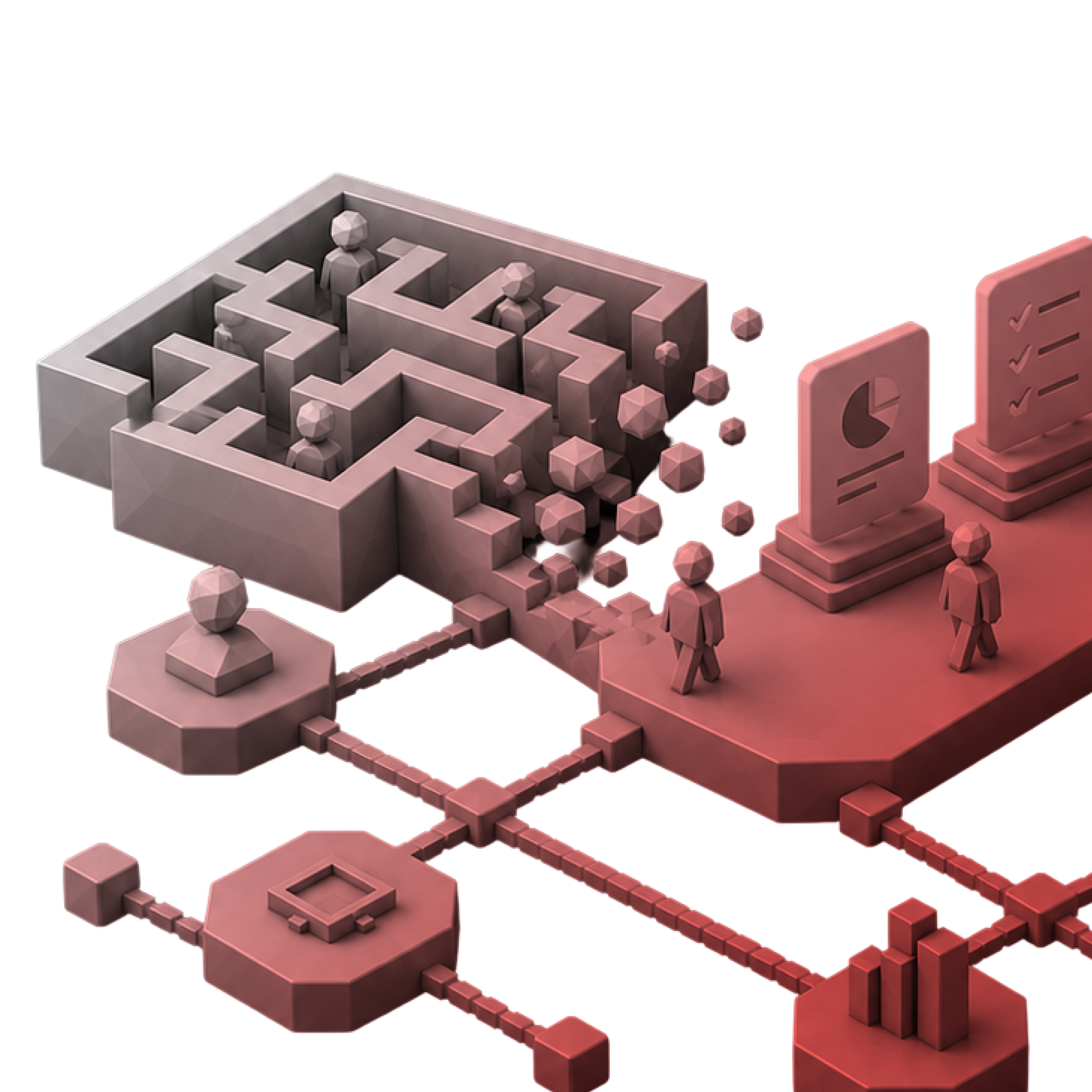
Enterprise products are used by people who did not choose them and cannot easily leave. Employees spend hours a day in tools selected by procurement, so poor design shows up as lost time, errors, workarounds, and support tickets rather than churn. Good enterprise UX makes complicated work faster and less error-prone, and it earns adoption from people who have every reason to resist another new system.
The complexity is structural. A single product may serve many roles with different permissions, views, and workflows. It sits on top of legacy systems, integrates with dozens of others, and must satisfy security, compliance, and accessibility requirements. Information density is high, and users expect speed, keyboard efficiency, and reliability more than delight.
The buying and delivery environment adds friction too. Decisions involve many stakeholders, timelines are long, and design has to survive procurement, IT review, and change management. The strongest agencies pair deep workflow research with disciplined interface design, systems thinking, and an ability to work inside large-organisation constraints.
NetBramha's Petrofac engagement covered operational tools for professional users working under strict process and safety requirements. The design work centred on information hierarchy, role-appropriate views, error prevention, and design systems that engineers could implement consistently at scale.
Their Yubi platform shows the same discipline in a data-heavy B2B fintech product, and HDFC demonstrates trust-critical design in a regulated banking context where security, privacy, and clarity are non-negotiable.
Users are professionals under time pressure — Petrofac shows dense, reliable tool design.
Several roles share one product — their work designs tailored views per role.
The domain is regulated or trust-critical — HDFC and Yubi show design under compliance constraints.
Very large global transformation — for programmes needing change management and technology delivery at scale, larger firms may fit better.
Highly specialised domain knowledge — confirm how they ramp up on niche sectors.
IDEO studies how work actually happens in an organisation, including the workarounds that never appear in process documents. That research helps avoid building tools that look right on paper and fail in practice.
They also help build internal capability, leaving teams better able to run their own research and design.
Real workflows are poorly understood — they observe work in context.
Adoption is a concern — they design with users to build buy-in.
Capability must grow — they coach internal teams.
Dense interface execution — confirm capacity for high-density UI at scale.
Speed — their research process takes time.
frog ties product design to business model and organisational change, useful when an enterprise is rethinking a product line or platform rather than refining one screen. Their teams shape the concept, the experience, and the business case together.
They work well at executive level and across many stakeholders.
Strategy must precede design — they align concept and business case.
Many stakeholders must agree — they work at senior levels.
Innovation is the aim — they explore new offerings.
Focused UI redesign — their model leans toward strategy.
Regional depth — confirm capability in your markets.
Deloitte Digital connects UX to the technology implementation and change management that large enterprises run. Their regulated-industry experience helps designs survive compliance and governance review.
They suit programmes where UX is one workstream in a wider platform rollout.
UX sits inside a platform programme — they manage design with delivery.
Adoption needs change management — they handle training and rollout.
Compliance shapes design — they understand governance.
Boutique craft — design seniority varies.
Design-only scope — confirm it can be contracted separately.
Fjord treats an enterprise product as part of a service system that includes people, processes, and other tools. Accenture's scale supports global rollouts and integrated delivery.
They suit large organisations that need design and implementation capacity from one group.
The product is part of a wider service — service design is their heritage.
Rollout is global — Accenture supports multi-market delivery.
Implementation must follow design — they connect the two.
Senior attention — confirm staffing model.
Focused scope — their model leans toward broader programmes.
Designit combines strategic design with engineering capacity, covering research through delivery. Their international studios support enterprise products launched across several countries.
Their service design skills align digital tools with operations and frontline work.
Programmes span countries — their studios support localisation.
Design must reach production — Wipro's capacity supports build.
Operations must align — service design covers frontline workflows.
Boutique attention — confirm team composition.
Sector examples — ask for directly relevant work.
Have they designed for professional users? Enterprise users value speed, density, and reliability over delight. Ask how the agency researches and tests with people who use the tool all day.
Can they handle roles and permissions? Enterprise products serve many roles with different views. Ask for examples of clear design across role-based experiences.
How do they work with legacy and integrations? Enterprise tools sit on old systems. Ask how the agency designs within technical constraints and works with your engineers.
How do they drive adoption? A tool people avoid delivers no value. Ask how the agency involves users, supports rollout, and measures adoption.
What do they deliver beyond screens? Design systems, specifications, and rationale help large teams build consistently. Ask for examples of handoff artefacts.
How much does enterprise product UX design cost?
A focused engagement for a module or workflow typically runs $60,000–$180,000. A comprehensive programme covering research, design, and a design system for a platform typically runs $200,000–$700,000.
Should I use a specialist or generalist agency?
A specialist helps in a niche domain with heavy terminology. A strong enterprise generalist works well when the main challenge is workflow, data, and role design, provided they invest in learning your domain.
How long does an enterprise UX project take?
Focused projects typically take 10–18 weeks. Platform programmes typically take 8–18 months, and rollouts and change management extend that further.
UX practice and digital product expectations differ by region — what signals quality and trust to a buyer in the US or UK is different from Dubai or Singapore. An agency with direct market experience brings depth that cross-industry portfolios cannot substitute.
UX & Enterprise Industry Hub →