.avif)



.avif)





Unparalleled insights tailored to empower your business.
Robust strategies with the agility demanded by today’s digital landscape.
Creating experiences that resonate with users and drive results.
Dublin has become a major European base for technology and financial services companies, with international businesses using the city to serve customers across Europe and beyond. The products built around that ecosystem often need to support different markets, user types, workflows, and increasingly sophisticated AI or financial capabilities.
That creates a product challenge beyond simply making an interface look good. An onboarding flow that works for one market may become difficult when requirements change. An enterprise platform can accumulate features faster than users can understand them. And an AI product can demonstrate impressive capability while still leaving users unsure about how to use it. The experience needs to scale alongside the product.
As products grow, UX often becomes the layer connecting functionality, onboarding, workflows, and user expectations. Clear product architecture helps new users understand where to begin. Better workflows help experienced users move faster. And thoughtful interaction design can make increasingly sophisticated capabilities feel approachable.
For Dublin's SaaS, fintech, AI, and enterprise companies, that means designing an experience that can support growth without adding unnecessary cognitive load. The goal isn't to reduce what the product can do. It's to make more of that capability usable.
NetBramha brings 18 years of experience across SaaS, fintech, AI, enterprise technology, healthcare, and consumer products. We combine user research, product strategy, information architecture, UX, and UI design to understand where users struggle and create experiences that help them reach value faster.
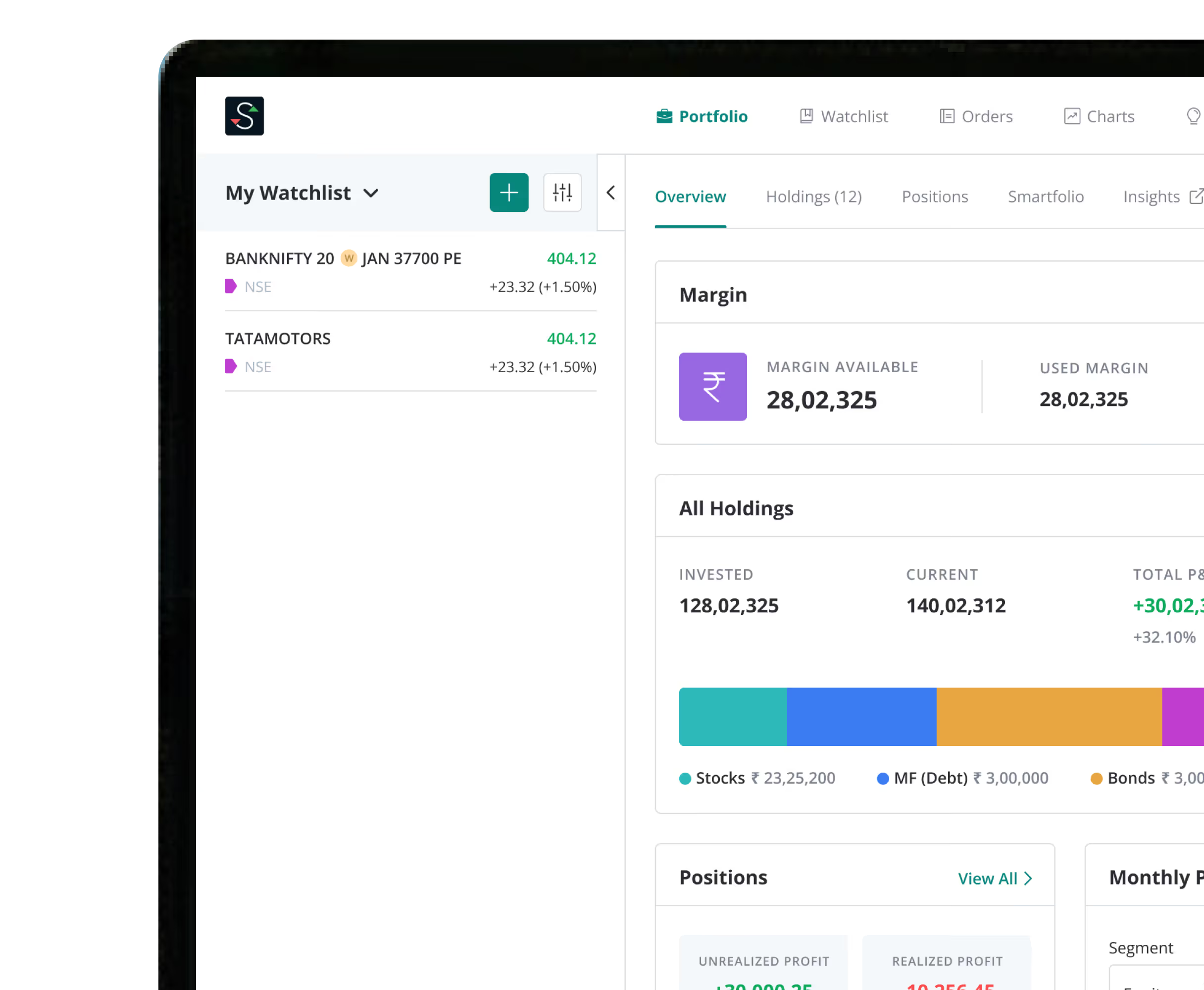
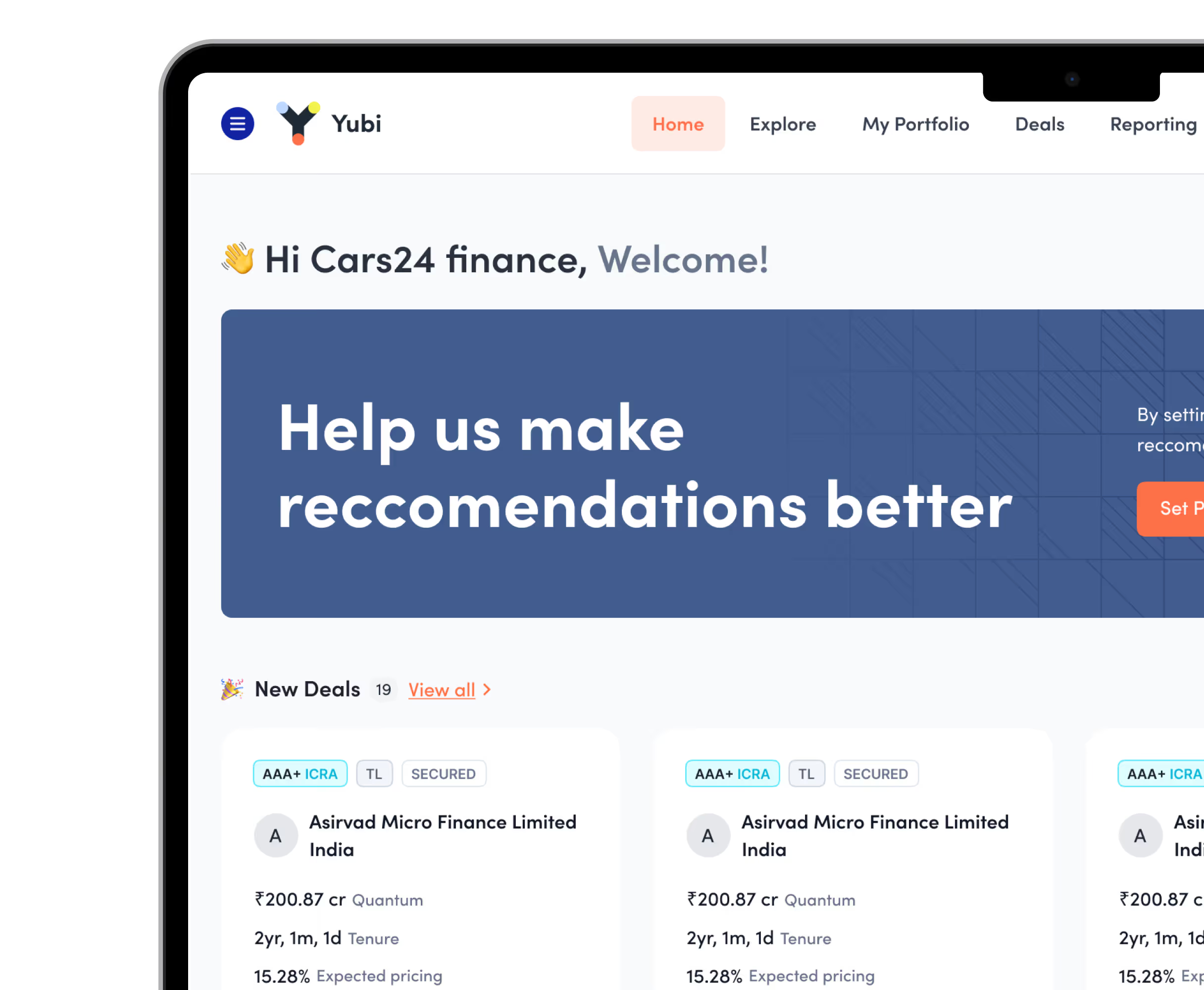
Our work includes Gyaan.ai, Cymorg, Yubi, and Prismforce, spanning AI-powered GTM software, enterprise learning, financial infrastructure, and workforce technology. We work collaboratively across time zones, with IST overlapping Irish working hours for real-time sessions.
If users need extensive onboarding, sales teams repeatedly demonstrate the same workflows, or customers aren't discovering capabilities already inside the product, adding another feature may not solve the underlying problem. The friction may be somewhere in the experience between first interaction and sustained use.
A 30-minute conversation will help determine whether UX is contributing to the problem and what addressing it would realistically involve.
No pitch. No deck. No proposal before we understand your product. Talk to NetBramha.

billion+ lives impacted with design so far
250+ Clients
25+ Countries
20+ Industries


They understand the user’s needs, research options out in the market, present different approaches, etc. I like how the designers feel passionately about my product & company. They’re not just trying to punch the clock.

Their attention to detail and willingness to do one extra iteration to get it right was impressive. Hard-working, no-nonsense bunch who were willing to roll their sleeves up. I genuinely believe they’re one of the best in the business.

Web traffic and conversions increased due to NetBramha Studios’ expertise. Their knowledge of UX/UI led to SEO improvements for the client. Their team’s innovative ideas set them apart from competitors.

NetBramha made sure the project is delivered to its best and had scope to upgrade as often as needed and even proposed ideas to enhance the Digital Footprint efficiency of Luminous through UX-UI uniformity and intersecting use cases.



A startup or for a Fortune 500 company, we follow a methodical & consistent approach to every design project we work on
Research – In-depth analysis of users through qualitative & quantitative analysis, ethnographic research, heuristic evaluation (through design audits), & usability testing, along with detailed competitor analysis.
Strategy – Powered by the insights derived in the research stage, we then work towards building a customer-centric product roadmap aimed at enhancing growth, product stickiness & market capture, through increased user engagement.
Design – Rugged information architecture, product mock-ups, user interface design, detailed motion & microinteractions, and finally customized illustrations & icons that set the apt succinct identity for your final product.
Since our inception 17+ years back our work has impacted more than a billion+ users worldwide. We take great pride in making a difference with design.
As an award-winning studio from India, our expertise involves everything that is needed to design (or redesign) a great user experience, including
– Website & Web app UX design
– Mobile UI/UX experience
– Enterprise UX design
– Branding & Illustrations
All of which is facilitated by rugged user research, product strategy, design thinking & deep craft for design.
We care for - People. (our team, clients & users)
Our people are our biggest strength. We care for our team & each one of them is hand-picked. Our culture is what drives us. Our care for our customers to see their problem as ours & empathy for the users is what makes us tick.
We care for - Design. (craft, outcomes, process)
We are absolutely passionate about design. We contribute to the design community, build our expertise & hone our skills every single day. We truly believe that design can change the world for better.
We care for - Outcomes (results, wins, learnings)
We are result driven & backed with experience. Our clients trust us to deliver results across experiences. Clients like Google, Microsoft, Cisco, Intel, Infosys, Emaar etc have mandated us to design new products, scale existing products or disrupt a new market with design.
SaaS products often need to balance a large feature set with a clear path for users who may only need a small portion of that functionality at first. As products grow, navigation, onboarding, dashboards, permissions, and workflows can become increasingly difficult to understand, particularly when different customer segments use the same platform in different ways.
UX design can help by restructuring the product around user goals rather than simply organising features. NetBramha's work with Cymorg involved designing an enterprise solution around complex learning and workforce requirements, while Gyaan.ai focused on making an AI-powered platform easier for revenue teams to use. These projects demonstrate how product architecture and UX can help sophisticated SaaS products become easier to adopt.
AI products can introduce a different usability challenge because users may not understand what the system can do, how to interact with it, or how much they should trust its output. A technically capable AI product can therefore struggle with adoption if the experience does not clearly communicate capabilities, actions, feedback, and limitations.
UX can make AI functionality more approachable by establishing clear interaction models, showing users what actions are available, providing understandable feedback, and designing workflows around the outcomes users are trying to achieve. NetBramha's Gyaan.ai and Prismforce projects provide relevant experience designing digital products where AI and complex workflows need to work together.
Expansion introduces additional complexity into an existing product. Different markets can bring new customer expectations, workflows, regulatory requirements, languages, currencies, and operational needs. If the underlying product architecture is not flexible, these additions can create inconsistent experiences and make the interface harder to navigate.
UX design can help establish scalable information architecture, reusable interaction patterns, flexible design systems, and clearer user journeys before that complexity becomes difficult to manage. NetBramha's experience across enterprise, fintech, SaaS, and global digital products provides a foundation for designing products that need to support different users and markets.






.avif)
.avif)