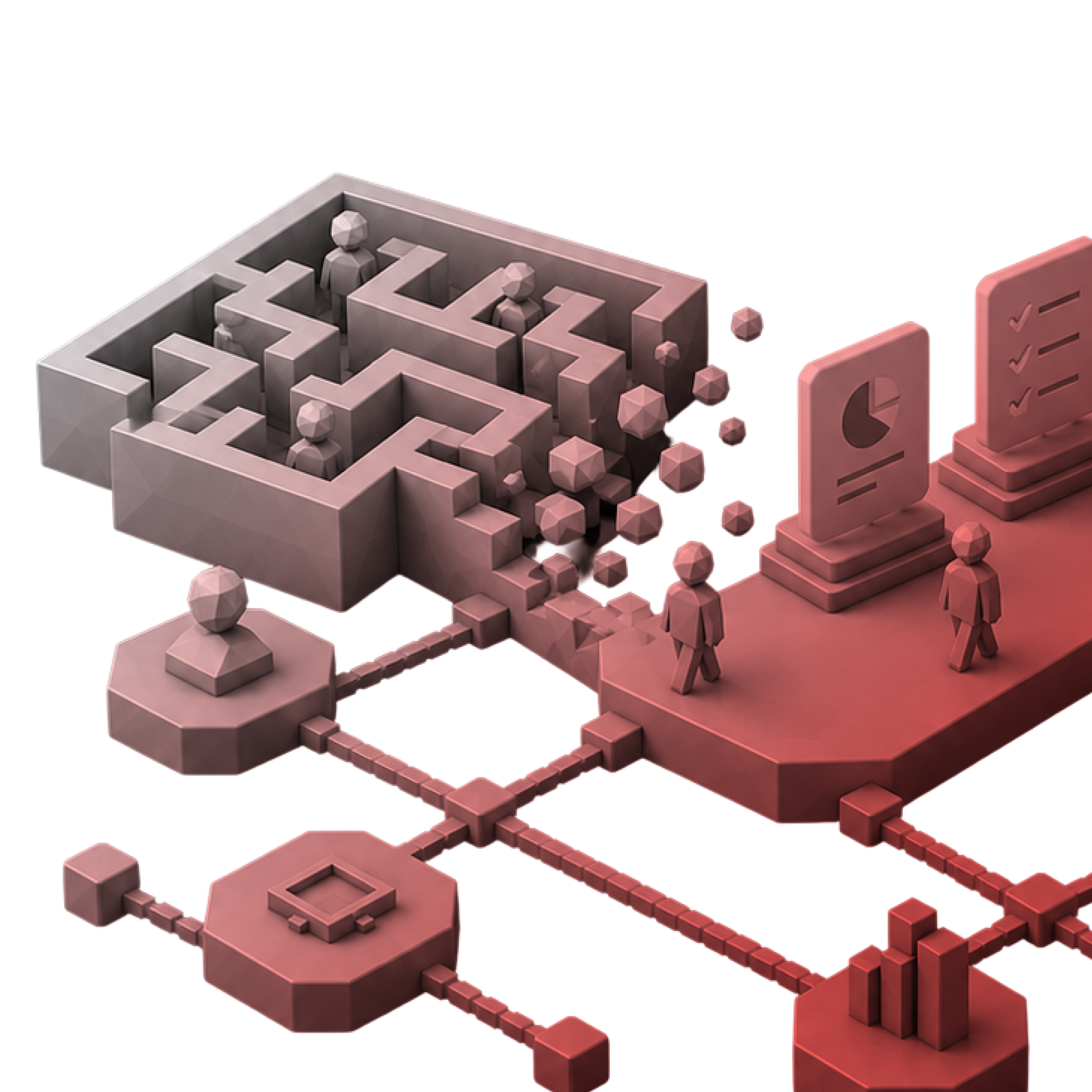
A design system is a product in its own right, with users, a roadmap, and a maintenance burden. Its users are the designers and engineers who build with it, and its success is measured by adoption and consistency rather than by how good any single screen looks. Agencies that treat a design system as a style guide deliver a document that goes stale; agencies that treat it as a product deliver something that teams keep using.
Clients need very different things. A scale-up wants to stop its interface drifting as squads multiply. An enterprise wants one system to unify dozens of products and brands. A company mid-rebrand wants tokens and components that carry a new identity through the whole estate. Each requires a different balance of audit, foundations, component design, documentation, and governance.
The hard part is not the components but the alignment between design and code. Tokens, naming, theming, accessibility, versioning, and contribution rules all determine whether a system survives contact with real teams. The strongest agencies design with engineers, ship in code where needed, and leave behind a model for how the system will be owned.
NetBramha builds design systems alongside product design, so components are proven in real screens and documented for engineers rather than invented in isolation. On Petrofac, that meant consistent patterns for professional tools with dense data, role-based views, and error handling that had to behave the same across many screens.
Their Yubi platform work required a coherent component language across a data-heavy B2B product, and SIXT shows consistent design across a multi-step mobility booking experience with many states.
The system must serve complex, multi-role products — their enterprise work builds patterns for dense data and roles.
Design and build must stay aligned — components are documented for engineering implementation.
You want the system built with the product — it is proven against real screens.
Code-level component libraries — confirm the extent of front-end implementation they provide versus design specifications.
Large multi-brand governance — for enterprise-wide governance across many teams, confirm the operating model support.
Ueno pairs systematic thinking with strong visual execution, producing systems that stay coherent across many states, roles, and features. Their work is documented for engineering and built to be extended.
They suit technology companies where interface quality is part of the product's appeal.
Product complexity is high — they maintain coherence across many states.
Visual quality matters — components carry a premium finish.
The company is technology-led — they understand product conventions.
Budget — premium rates apply.
Governance at enterprise scale — confirm operating model support.
Work & Co focuses on component quality, motion, and interaction detail, with senior designers directly on the work. Their systems carry a brand's character into behaviour, not just appearance.
They suit brands where the quality bar is very high.
Craft is the differentiator — their finish level is very high.
Brand must show in behaviour — they translate identity into interaction.
Senior attention is needed — their model keeps senior people involved.
Budget — premium rates apply.
Enterprise tooling — their focus is consumer products.
Instrument connects brand and product, carrying visual identity into tokens and components used across web and mobile. Their process links strategy to execution.
They suit companies rolling out a new brand across their digital estate.
A rebrand must reach the product — they carry identity into components.
Web and mobile need one language — they design across platforms.
Brand and product teams must align — they bridge both.
Complex enterprise tooling — their strength is consumer-facing work.
Code-level libraries — confirm implementation scope.
frog links design systems to organisational strategy, helping large companies decide who owns the system, how teams contribute, and how it is funded. Their consulting approach suits multi-product, multi-team environments.
They fit enterprises where governance is as hard as design.
Many teams and products are involved — they design operating models as well as components.
Executive support must be won — they connect the system to business value.
Governance is the challenge — they address ownership and contribution.
Component-level craft focus — their model leans toward strategy.
Local market depth — confirm capability in your regions.
Designit combines design strategy with engineering capacity, covering system design through implementation. Their international studios support rollouts across several countries and brands.
Their service design skills help embed the system in how teams work.
The system rolls out across markets — their studios support localisation.
Engineering capacity is needed — Wipro's capacity supports build.
Adoption needs support — they address ways of working.
Boutique attention — confirm team composition.
Design-system-specific examples — ask for directly relevant work.
Do they treat the system as a product? Ask about users, roadmap, and ownership. A system without a maintenance plan decays within a year.
How tightly do design and code align? Ask about tokens, naming, theming, and how components map between design tools and code. Misalignment is the main cause of drift.
How do they handle accessibility? Accessibility should be built into components, not added later. Ask which standards they design and test against.
What is the adoption plan? Ask how teams will discover, use, and contribute to the system, and how success will be measured.
Have they worked at your scale? A system for five squads differs from one for fifty. Ask for comparable examples and how they handled versioning and change.
How much does a design system cost?
A foundational system with tokens and core components typically runs $40,000–$120,000. A comprehensive system with documentation, governance, and code alignment typically runs $100,000–$350,000, with ongoing maintenance on top.
Should I use a specialist or generalist agency?
A specialist helps at enterprise scale where governance and code alignment dominate. A product design agency that builds systems alongside the product works well when the system needs to be proven in real screens.
How long does a design system project take?
Foundational systems typically take 8–14 weeks. Comprehensive systems typically take 4–8 months, and adoption continues well beyond delivery.
UX practice and digital product expectations differ by region — what signals quality and trust to a buyer in the US or UK is different from Dubai or Singapore. An agency with direct market experience brings depth that cross-industry portfolios cannot substitute.
UX & Enterprise Industry Hub →