.jpg)
Designing an AR-driven social experience blending avatars and real-world interaction
The challenge was to design an intuitive mobile experience that supports AR capture, social sharing, messaging, and profile interactions within a cohesive interface.
Our mission was to design a mobile AR experience that seamlessly integrates camera interactions, avatar creation, and social engagement into a unified user journey.
with camera-led AR experiences positioned at the core of the product.
with customizable avatars integrated into social and content flows.
with messaging, group chats, and feeds unified within the same interface.
with clear profile creation and authentication flows simplified user entry.
Real-time camera interaction designed for intuitive content creation.
Users could personalize digital identities within the app ecosystem.
Media-rich scrolling experiences built for engagement and interaction.
Custom avatars and shared media screens creating deeply immersive AR/VR interaction experiences.
.avif)
.avif)
Real-time camera interaction designed for intuitive content creation.
Real-time camera interaction designed for intuitive content creation.
Users could personalize digital identities within the app ecosystem.
Users could personalize digital identities within the app ecosystem.
Media-rich scrolling experiences built for engagement and interaction.
Media-rich scrolling experiences built for engagement and interaction.
Custom avatars and shared media screens creating deeply immersive AR/VR interaction experiences.
Custom avatars and shared media screens creating deeply immersive AR/VR interaction experiences.
For Augray, we designed immersive AR experiences within a structured, socially connected mobile platform.
through real-time avatar interaction
through social interaction layers
through connected AR ecosystem
.jpg)
Full-screen media layouts support immersive viewing, with edge-aligned interaction icons enabling seamless engagement.
.avif)
Wireflows map the journey from onboarding to feature access, defining relationships across streams, messages, and tasks.
.avif)
.avif)
Low-fidelity explorations structure authentication, profile, chat, recording, and dashboard flows before visual design.
.avif)
.avif)
The refined interface applies a clean visual system ensuring continuity across profiles, chats, feeds, and content creation.


Augray is an AR-powered smart messaging and brand activation platform blending user avatars with real-world interaction. NetBramha designed the social experience layer, working in a category with no established UX conventions to draw from.
Unlike a banking or e-commerce redesign, there was no existing pattern library for avatar-based AR social interaction to reference - NetBramha had to originate interaction conventions rather than refine known ones, a distinct discipline it also applied to Google's motion-tracking cricket experience.
Spatial computing interactions - how a user's avatar moves, how real-world and digital elements blend, how brand activations trigger through augmented reality - don't have the decade of established convention that mobile and web design can lean on.
That greenfield-convention problem is rare in NetBramha's portfolio; most projects, even ambitious ones like Gyaan.ai's B2B dashboard redesign, still work within well-established web and mobile interaction patterns rather than inventing new ones.
Augray serves brands looking to create AR-based activations and messaging experiences that go beyond static social media content, combining avatar identity with real-world augmented reality overlays for engagement campaigns.
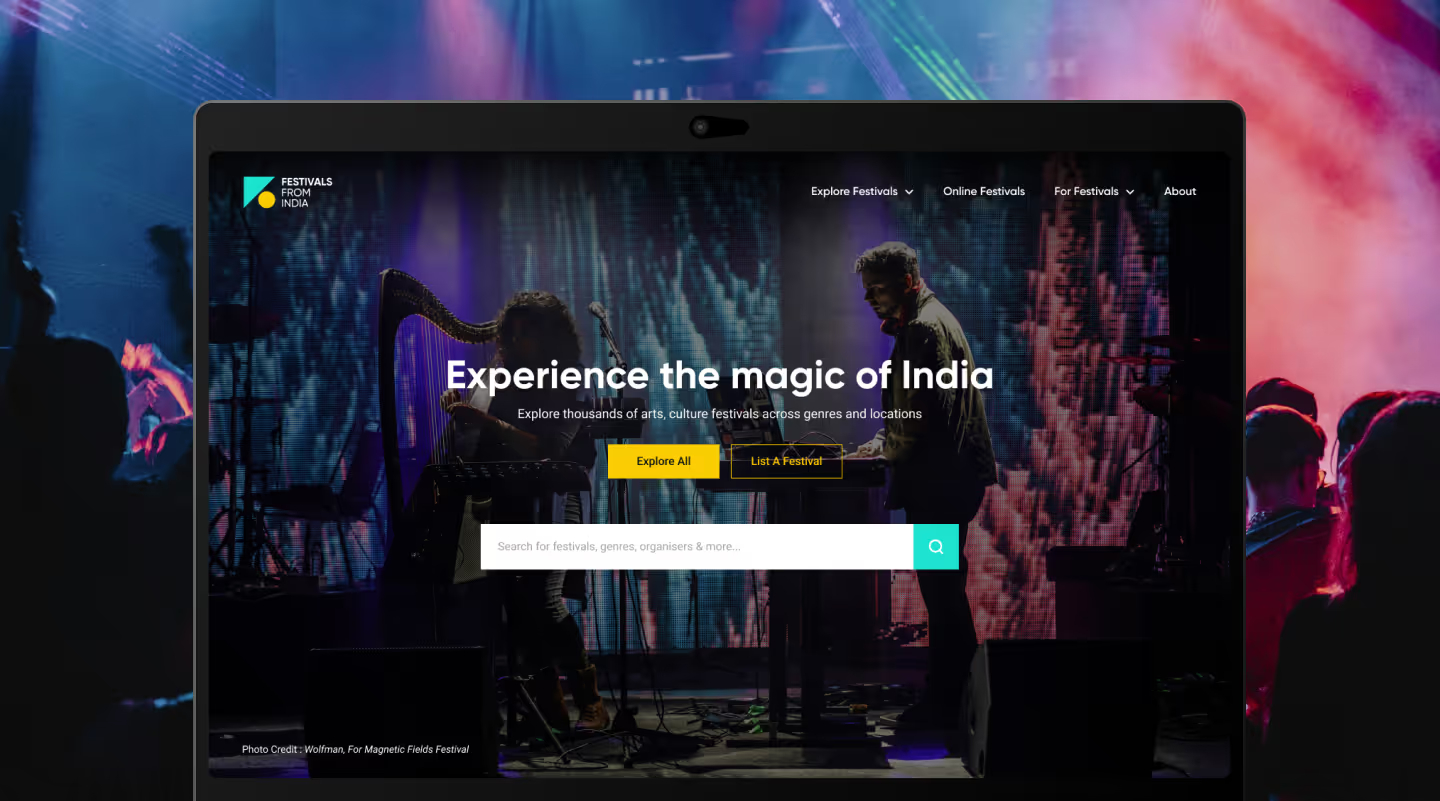
That brand-activation use case sits closer to marketing technology than to NetBramha's typical enterprise or fintech software, making Augray one of the more experimental, less transactional projects in its portfolio, alongside Festivals From India.
NetBramha's approach on Augray involved rapid prototyping and testing of avatar and AR interaction concepts directly with users, since there was no existing benchmark to design against or compare results to.
That prototype-and-validate approach differs from a typical redesign, where NetBramha can benchmark against the existing product's known pain points; on Augray, the pain points themselves had to be discovered through the design process, not identified upfront.
Augray sits alongside the Google AI cricket experience (PoseNet motion tracking) and TVS's connected EV cluster app (real-time vehicle telemetry) as NetBramha's clearest emerging-technology credentials - three different technical domains (AR, computer vision, IoT) united by the same need to design interaction patterns that didn't already exist.
Recommended Next